Utsuroi, a journal for letting go
Oct. 11, 2026[interactive] A journal where most of what you write isn’t kept. You give it to a place: the tide washes it from the sand, the wind carries it off, a candle burns the letter. What you want to keep, you carve into a stone and set on a cairn.
移ろい
移ろい (utsuroi) comes from the verb 移ろう: to shift, to fade, to pass from one state into the next. In classical Japanese poetry it’s the word for blossoms losing their color, for one season turning into another, and for a heart quietly changing. The best-known example is a poem by Ono no Komachi from the ninth century, collected in the Kokinshū:
花の色は 移りにけりな いたづらに わが身世にふる ながめせしまに
The flowers’ color has faded, all for nothing, while I grew older in this world, gazing out at the long rain.
The feeling behind it is close to mono no aware: a gentle awareness that things pass, and a tenderness toward them because they do. Utsuroi isn’t loss so much as change. The fading is part of what made the color beautiful.
The home page also shows the day’s micro-season, one of the 七十二候, seventy-two seasons of about five days each, like 鴻雁来, “wild geese return.” They began in ancient China and were later adapted in Japan, a thread between the culture I grew up in and the word I chose for this. The page changes every few days, which felt like the most honest way to say utsuroi without explaining it.
Four places
Each place comes from something I’ve seen or done since I was small.
The ocean. As a kid I would write all sorts of things in the sand with a stick and watch the waves wash them away. The thoughts dissolved, and the message was passed along, taken by the sea. Zhang Yusheng’s song 大海 (The Sea) was part of that feeling too. Rest in peace, Zhang Yusheng (1966–1997).
The wind. There were dandelions all over the fields in Beijing where I grew up. I’d snap one off at the stem, blow as hard as I could, and watch the seeds float off into the wind.
The fire. Around Qingming, I remember people burning things at the side of the road in China: paper offerings and belongings, sent off to the dead, or away from their own past.
The stone. Traveling through quiet coastal towns in North America and Europe, I kept finding cairns beside a lake or a beach, stacked in memory of something or someone. In the app, the stone is the one place where words stay.
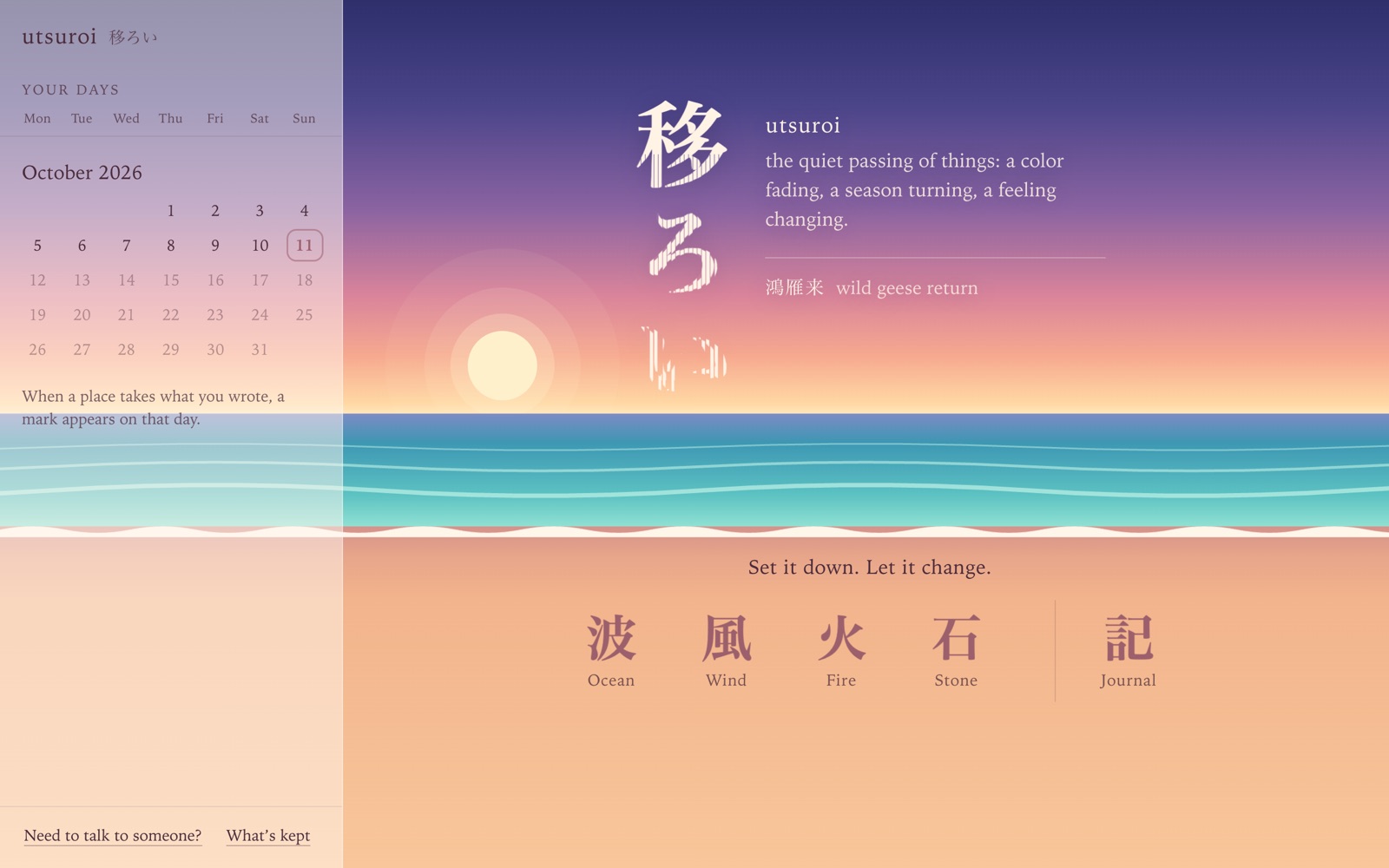
Choose a place, then write. Released words are never saved anywhere; each place only leaves a small mark on the day. Stones and plain journal entries stay on your device, and you can download them as a readable file whenever you like.
It’s still growing. I’ll keep improving it, and add new places as more inspirations come along.